

Once we have mastered the identification of electronic components, our next step is to learn to identify circuit symbols.
Because we need to identify the circuit symbols in a circuit diagram to determine which electronic component it represents.
Therefore, in order to ensure that we are able to carry out our subsequent studies successfully, we need to understand the identification of circuit symbols first.
In a circuit diagram, the circuit symbols of electronic components are used to represent the components.The following figure shows the circuit symbols of several common electronic components:
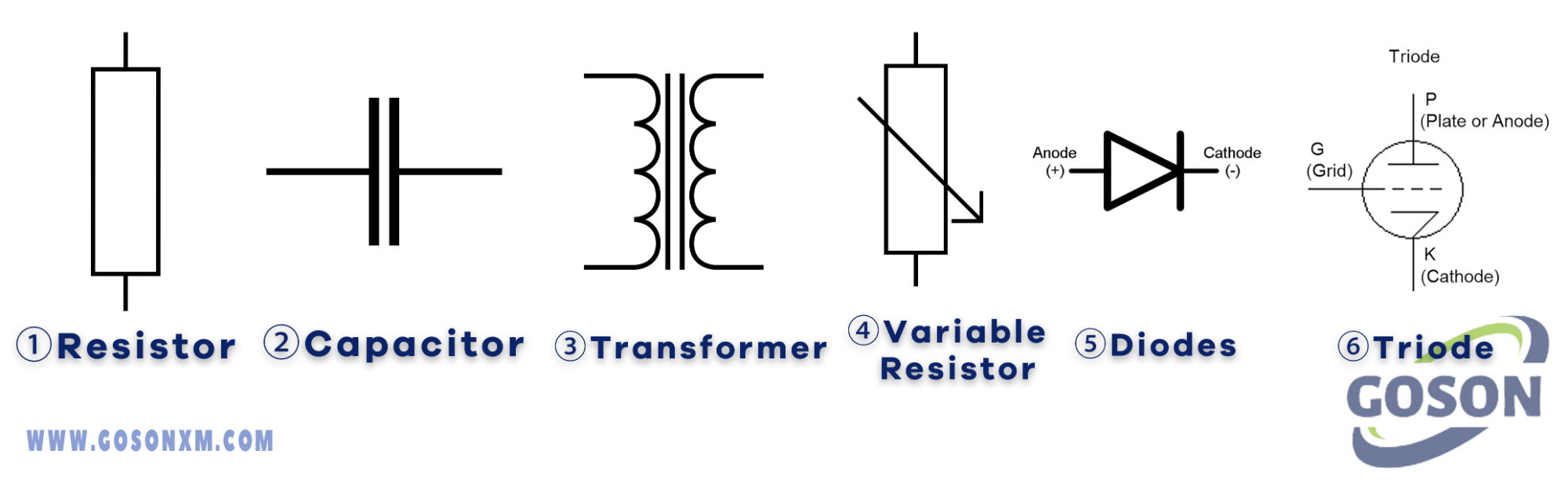
Figure ① shows the resistor circuit symbols, from this symbol can get two information: there are two pins do not distinguish between positive and negative polarity, the resistor with the letter R represents.
Figure ② shows an ordinary capacitor circuit symbol without polarity, it has two pins without positive and negative polarity, there is another electrolytic capacitor two pins have positive and negative polarity, the circuit symbol is different from this. Capacitor with the letter C.
Figure ③ is shown in the transformer circuit symbols, more types of transformers, specific structural changes, different transformers in the circuit symbols have changed. One point to note is that the circuit symbol can indicate the structure of its primary and secondary coils. The transformer is shown by the letter T.
Figure ④ shows the circuit symbol for a variable resistor, which has three pins. The circuit symbol is basically similar to that of a resistor, but an arrow is used in the symbol to indicate that the resistance value of this resistor is variable. The variable resistor is indicated by the letter RP.
Figure ⑤ shows the diode circuit symbol, which has two pins with positive and negative polarity, and indicates the positive and negative polarity pins in the circuit symbol. The diode is represented by the letter VD.
Figure ⑥ shows the triode circuit symbol, and its three pins can be distinguished by the circuit symbol. The triode is represented by the letter VT, and the three electrodes are represented by P for Plate/Anode, K for Cathode, and G for Grid.